Process · February 18, 2026 · 5 min read
A practical checklist for effective product design
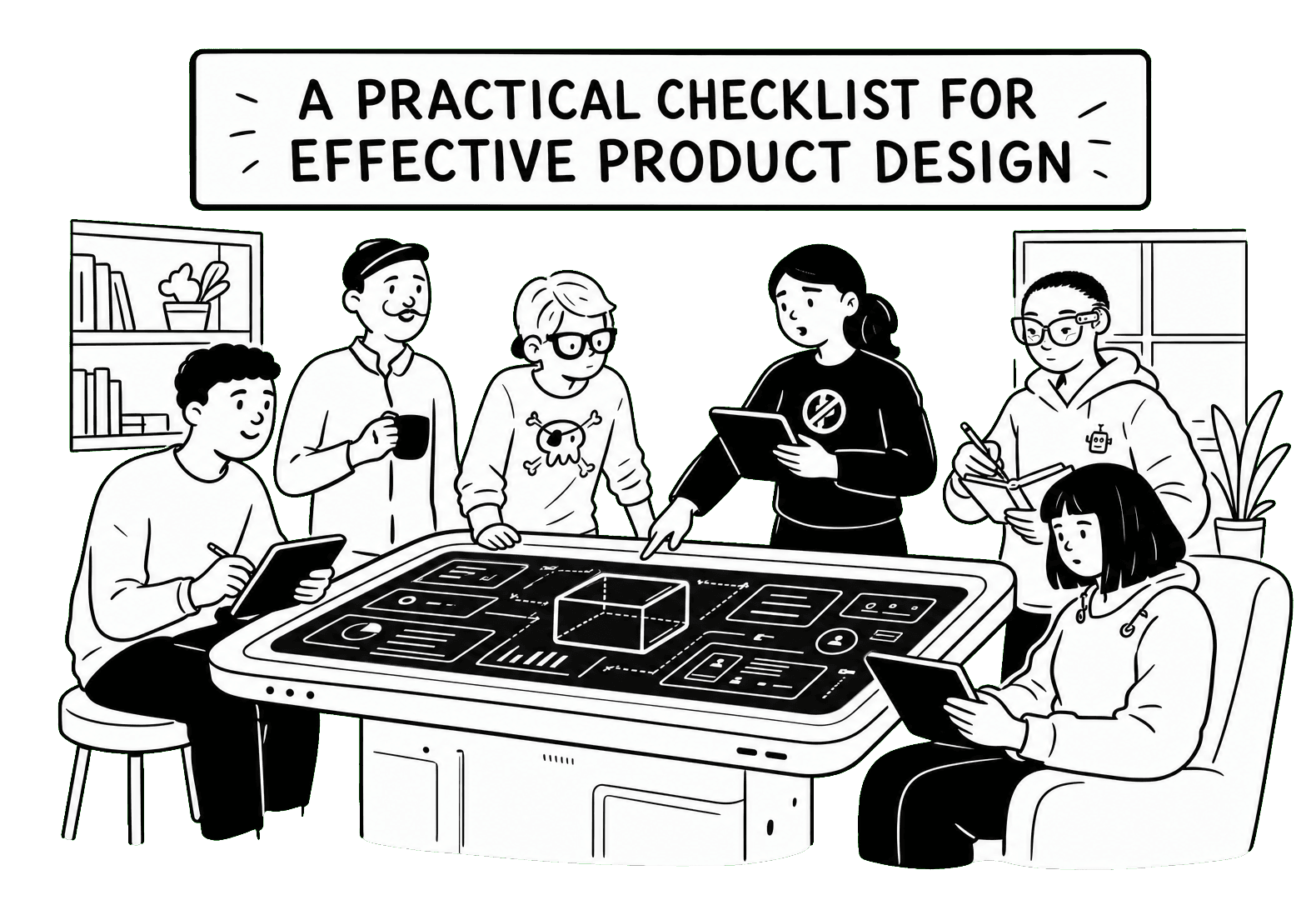
Every studio accumulates scar tissue: lessons learned from designs that demoed beautifully and failed quietly in production. Ours eventually condensed into a checklist. It isn't glamorous, but it catches the failures that reviews built around aesthetics miss completely.
Does it survive real data?
Mockups are full of names like 'Anna Smith' and tidy two-word titles. Production is full of 47-character German compound nouns, empty fields, and lists with one item or ten thousand. We test every layout against the ugliest data we can construct — because production will construct worse.
Does every state exist?
The happy path is maybe a third of the design. Loading, empty, error, partial, offline, permission-denied — each is a screen someone will see, and an undesigned state is still a designed experience, just a bad one.
Our rule: a flow isn't ready for engineering until its unhappy paths are as resolved as its hero screen.
Can a tired person use it?
Design reviews happen on big monitors with full attention. Real usage happens on a phone, on a train, at 30% battery and 20% attention. Touch targets, contrast, and copy length all need to pass the tired-person test, not the conference-room test.
Is the next step always obvious?
At any moment in a flow, the user should be able to answer: where am I, what just happened, what can I do next? If a screen fails any of those three questions, no amount of visual refinement rescues it.
Did we close the loop?
Shipping is the midpoint. The checklist's final item is instrumentation: how will we know whether this design worked? A design without a success metric isn't finished — it's abandoned at the moment of maximum optimism.