Design · March 10, 2026 · 7 min read
Timeless principles of good design, applied to software
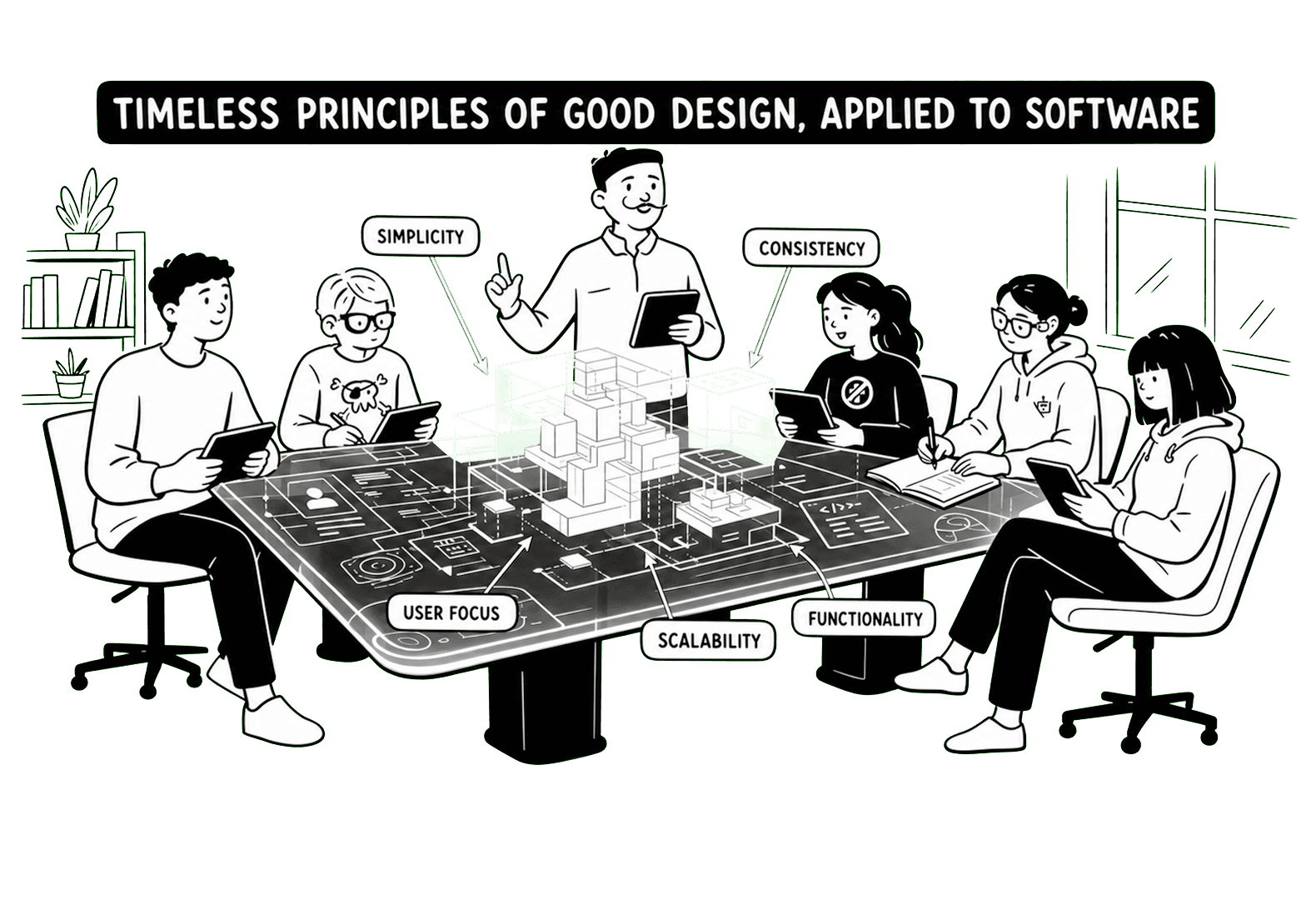
Long before software ate the world, industrial designers were arguing about what makes an object good — and the conclusions they reached have aged remarkably well. Honesty, restraint, usefulness, longevity. Reading that tradition as a product designer is humbling, because it describes everything we still get wrong on screens.
Here's how we translate those fundamentals into our daily software work.
Good design is honest
An honest interface doesn't promise what the system can't deliver. Progress bars that crawl to 90% and stall, 'AI-powered' labels on simple rules, fake urgency timers — these are the software equivalent of fake wood grain. Users notice, and trust never fully recovers.
Honesty also means showing system state truthfully: if something failed, say so plainly and say what happens next.
Good design is as little design as possible
Restraint is the hardest discipline in product work because addition is how teams demonstrate effort. But every control, badge, and banner competes for the same finite attention. The question isn't 'does this feature help someone?' — almost everything helps someone. The question is 'does this earn its cost in attention for everyone else?'
Our practical version: each screen gets one primary job. Everything that doesn't serve that job must justify its presence or leave.
Good design is long-lasting
Trend-driven interfaces date like trend-driven furniture. The products that still feel right after five years are built on typography, spacing, and hierarchy — not on whatever shadow style is fashionable this quarter.
This is also an economic argument: every visual trend you adopt is a redesign you're scheduling for later.
Good design is thorough, down to the last detail
Users may not consciously notice a well-considered empty state, a sensible tab order, or an error message that actually helps. But they feel the accumulation. Care is perceptible in aggregate.
The details are not the polish phase. The details are the product.